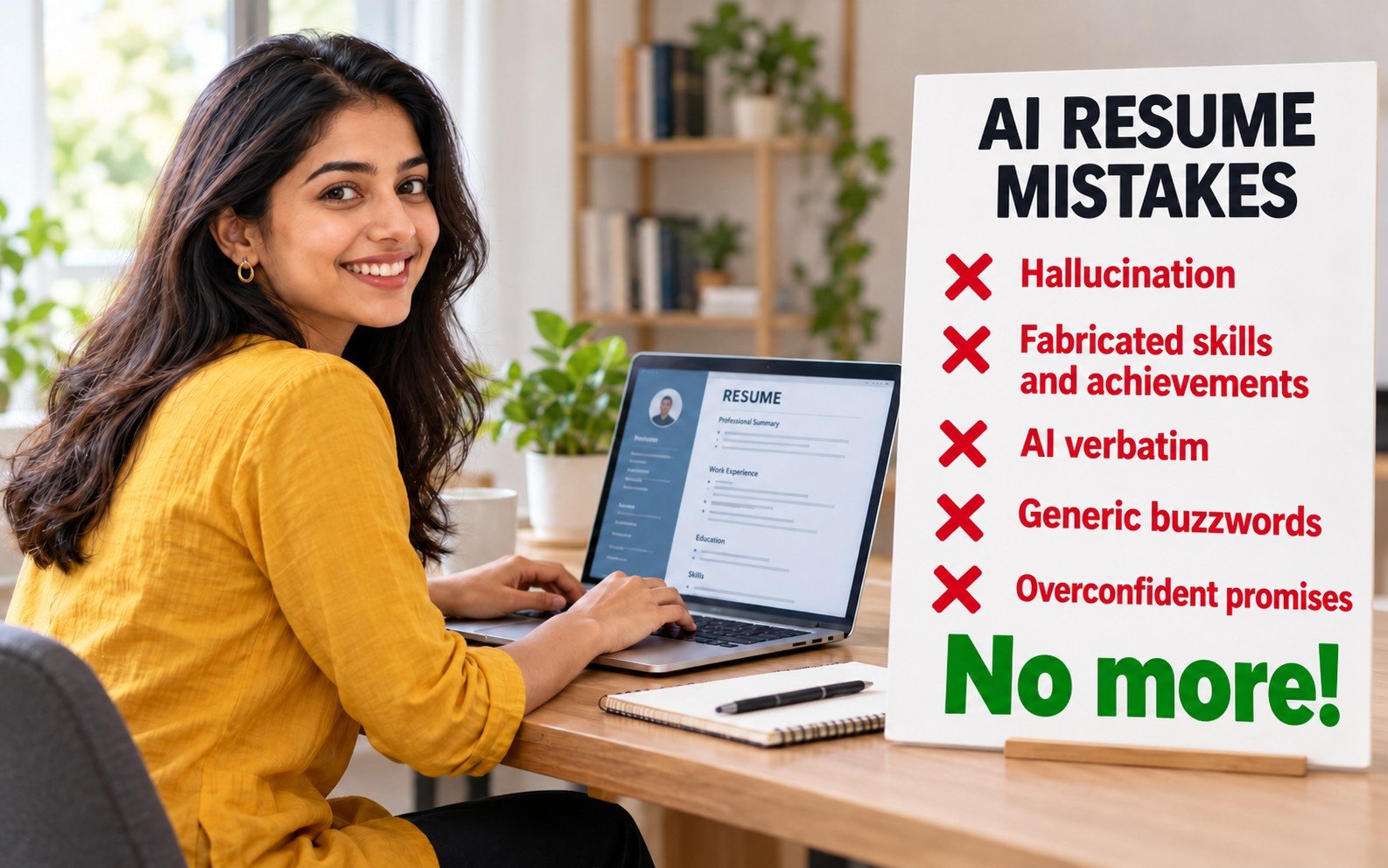
AI can help you create a resume faster than ever before. You can paste your experience into a chatbot, ask it to write a professional resume, and receive a polished document in seconds.
But a polished resume is not necessarily a good resume.
AI may introduce accomplishments you never achieved, add skills you have not used, exaggerate your responsibilities, or fill your resume with keywords copied from a job description. The result may look impressive on paper but become a liability when a recruiter asks questions during an interview.
The best way to create a resume using AI is to combine AI-assisted writing with structured competency evaluation, factual verification, and alignment with a specific target role.
This approach helps you create a resume that is relevant to the job, readable by Applicant Tracking Systems (ATS), and defensible in an interview.
1. Why Using a General AI Chatbot Alone Can Be Risky
General-purpose AI tools are useful for writing and editing. However, asking an AI chatbot to create an entire resume in one step has several limitations.
Risk 1: AI may invent experience and accomplishments
AI systems can generate plausible-sounding information that is not supported by the input.
For example, if your resume says:
“I worked with the sales team to improve customer engagement.”
An AI tool might rewrite it as:
“Led a cross-functional initiative that increased customer engagement by 35% and generated $500,000 in additional revenue.”
The second statement sounds more impressive, but the metrics and leadership responsibility may be entirely fabricated.
Even when AI does not invent explicit numbers, it may exaggerate your ownership of a project, imply expertise you do not possess, or turn participation into leadership.
A resume should improve the presentation of your experience without changing the facts.
Risk 2: AI may stuff your resume with skills and keywords
When given a job description, AI may try to maximize the overlap between the job requirements and your resume.
Suppose a job description asks for Python, SQL, cloud computing, machine learning, and production deployment experience.
A candidate who has completed a Python course and built a small academic project might receive a resume that presents all five areas as established professional competencies.
This creates two problems:
- The resume may misrepresent the candidate’s actual capabilities.
- The candidate may struggle to answer technical questions about the listed skills during an interview.
Keyword matching is useful, but it should never take priority over factual accuracy.
Risk 3: One-shot resume generation skips important thinking
A resume is not simply a document that needs better wording. It requires the candidate to identify relevant experience, recognize strengths, select evidence, and decide what to emphasize for a particular role.
A one-shot AI prompt can skip this process.
Instead of asking the candidate to clarify their contribution, explain an accomplishment, or distinguish between theoretical knowledge and practical experience, the AI may immediately generate a complete resume.
The document may look finished before the candidate has adequately examined the claims it contains.
Risk 4: A generic resume may not communicate job readiness
Two candidates with similar qualifications can have very different levels of readiness for the same position.
One may have theoretical knowledge. Another may have applied the knowledge in a project. A third may have independently delivered production work and handled the associated challenges.
Simply listing the same skills does not communicate these differences.
A good resume should help a recruiter understand not just what a candidate knows, but also how the candidate has demonstrated relevant capabilities.

2. What Makes a Good AI-Generated Resume?
A reliable resume-building process should meet five requirements.
1. Factual accuracy
Every qualification, skill, responsibility, project, and accomplishment should be supported by the candidate’s actual background.
AI can help clarify an achievement, improve its wording, and make the candidate’s contribution easier to understand. It should not invent evidence or manufacture impressive metrics.
2. Competency-based presentation
Employers evaluate candidates against the capabilities required for a role. Depending on the position, these may include technical knowledge, problem-solving, communication, planning, execution, leadership, and collaboration.
A resume should make relevant competencies visible through evidence from work experience, projects, education, and other appropriate activities.
For example, instead of merely listing “problem-solving,” a candidate could describe a real instance in which they identified a technical issue, investigated its cause, and implemented a solution.
The specific competency framework should reflect the role being targeted rather than a generic list of desirable qualities.
3. Relevance to the target job
A good resume is not necessarily the longest or most comprehensive account of a candidate’s career.
It is a selective presentation of the candidate’s most relevant qualifications and evidence.
The same candidate may need to emphasize system design for one position, project execution for another, and technical problem-solving for a third.
A target job description helps determine which parts of the candidate’s experience deserve greater emphasis.
4. ATS-friendly structure
An Applicant Tracking System may parse resumes, organize candidate information, support recruiter searches, and assist with screening workflows.
To improve compatibility, use a clear structure with conventional headings such as:
- Professional Summary
- Skills
- Work Experience
- Projects
- Education
- Certifications
Use readable fonts, consistent dates, clear job titles, and straightforward bullet points. Avoid relying on complex tables, graphics, icons, or elaborate layouts to convey essential information.
Use relevant terminology from the job description when it accurately describes your experience.
With CareerPlan, this is automatically taken care. Just sign up FREE at https://www.careerplan.app and pick a goal. All goals take you through resume tuning.